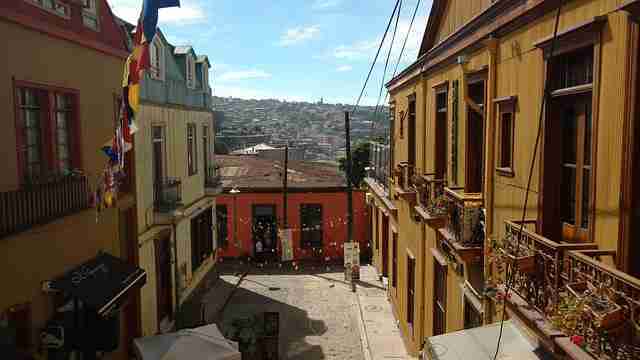
Few places capture the spirit of somewhere as fully as Valparaíso, Chile. A ramshackle collection of rainbow-hued houses clinging to hillsides, lined with rickety funiculars and spattered in street art, Valparaíso is not shiny—and that’s precisely why it’s so charming. It’s tough-around-the-edges, bohemian, old, and perpetually creative. You don’t come to Valparaíso to check things off a list. You come to get lost, to drink in the rhythm of the hills, and to discover art around every corner.
Valparaíso: A Hill City with Heart
Known as “Valpo,” this seaport city sprawls over more than 40 cerros (hills), each of which has its own personality. The city slopes downward toward the Pacific Ocean, where Chile’s greatest historic port used to be full of foreign trade. Much of that ocean life has now shifted to adjacent San Antonio, but Valparaíso remains a city with energy—just a different, more artistic one.
The city’s historic center, a UNESCO World Heritage Site, is a treasure of 19th-century architecture, hidden stairways, and crumbling mansions. Time does not move here. Laundry blows in the breeze, dogs rest in doorways, and music drifts from open windows.
A Living Street Art Museum
Valparaíso is often called an open-air museum, and rightly so. Its streets are painted with colour. From stunning murals to spontaneous graffiti, street art in Valpo is everywhere. Walls, doors, staircases—entire buildings—are canvases. Local artists, and international ones too, have made the city one of the world’s street art capitals.
Two of the finest cerros on which to explore this artistic outburst are Cerro Alegre and Cerro Concepción. Here, there are narrow streets filled with cafes, galleries, and shops. Wander at leisure, camera at the ready—around every corner is a revelation. Some are political, others poetic, but all are an exchange between city and people.
And not only are the murals colorful. The houses themselves are a rainbow of colors—turquoise, coral, sunflower yellow, flamingo pink. It’s as if Valparaíso collectively decided that no wall would ever be left bare.
The Funiculars of Valparaíso
Getting around Valpo is an adventure in itself. The city’s iconic ascensores (funicular elevators) creak their way up and down the steep hills, offering a nostalgic (and practical) way to travel. Many of these date back to the late 1800s and are still in use today, though some are undergoing restoration.
The Ascensor Reina Victoria, Ascensor El Peral, and Ascensor Concepción are among the most popular, not just for the ride but for the stunning vistas from the summit. Taking one of these antique elevators is to step into another era—and a welcome respite from climbing the city’s endless stairs.
Culture and Creativity
Valparaíso has been a magnet for poets, musicians, and bohemians for decades. Its most celebrated resident was Pablo Neruda, who built one of his fantastical homes here: La Sebastiana. Perched on a hill overlooking the bay, the house now functions as a museum filled with eccentric trinkets—sea charts, music boxes, and bizarre furniture. A stop here gives insight into both Neruda’s existence and the character of the city he loved.
The artistic flame is kept alive in the city’s vibrant cultural scene. Valpo boasts tiny theaters, craft markets, live music venues, and film festivals. Nights are filled with street performances and bars tucked away in unlikely places, where you can listen to anything from folk to cumbia to jazz.
Food and Flavour by the Sea
Valparaíso’s culinary scene is a blend of coastal tradition and creative flair. Being a port city, it’s no surprise that seafood takes centre stage. You’ll find everything from simple fried fish at local markets to elegant ceviche served in hilltop bistros.
Order the chorrillana, a regional Valpo staple made with fries, steak, onions sautéed to caramelized perfection, and eggs—comfort food at its finest. Have it with a pisco sour or a glass of crisp Chilean Sauvignon Blanc while watching the sun set over the Pacific.
For a true local flavor, go to the Mercado Cardonal, a vintage market with vendors selling produce, seafood, and street food. It’s a great place to have an empanada and people-watch.
Day Trips and Nearby Escapes
Valparaíso is conveniently located for the exploration of Chile’s central coast. A few minutes’ bus or taxi journey away is Viña del Mar, a more urbane beach resort renowned for its gardens, casinos, and summer festivals.
The best way to get to Santiago from Valparaíso without a car is to bus which takes 1h 40m
Wine enthusiasts can head inland to the Casablanca Valley, one of Chile’s best wine-producing areas. The coastal climate with its cooler temperatures produces better whites and Pinot Noirs. Vineyards offer tastings, tours, and gourmet meals among the vineyards.
When to Visit
Valparaíso can be visited throughout the year, but the best time to go is during the summer months of Chile (December to March), with clear skies and warm evenings. This is also when the city observes its most famous festival: New Year’s Eve fireworks. Thousands flock to the hills to witness the sky ignite with colour over the harbour—a spectacle as lively as the city itself.
Spring and autumn (October-November and April-May) are also pleasant times to visit, with mild temperatures and fewer tourists.
Final Thoughts
Valparaíso is not a postcard-perfect place in the classical sense—it’s layered, weathered, and gloriously disorganized. But that’s precisely what makes it unforgettable. It’s a city that beckons to be explored, rewards curiosity, and honors imperfection.
Whether you visit for the art, the poetry, the scenery, or just the pleasure of strolling with no agenda, Valparaíso makes its mark. It doesn’t merely introduce you to its colours—it gives you its soul.
Image by Fabiana pfernandes from Pixabay