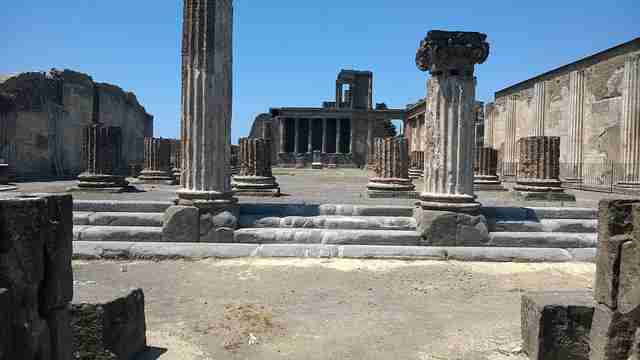
Pompeii, the Roman city frozen in a flawless time capsule by Mount Vesuvius’s catastrophic eruption in AD 79. The commercial, cultural, and daily life hub, Pompeii is today one of the world’s finest archaeological treasures. The city ruins provide a rare opportunity to step into the past and witness the glory, tragedy, and resilience of a people lost forever by nature but not by war or mere mortality hands.
The Emergence of Pompeii
Pompeii originated in the 6th or 7th century BC when the Oscans, who were a prehistoric Italic tribe, founded it. The town then came under the influence of the Greeks and Etruscans before eventually becoming a Roman colony in 80 BC. With the strategic location of the town near the Bay of Naples, this ancient city thrived as a center for commerce, agriculture, and tourism. The city’s wealth was manifest in its luxurious villas, elaborate frescoes, and sophisticated infrastructure, including a highly advanced water supply system and neatly laid-out roads.
By the 1st century AD, the city contained between 10,000 to 20,000 people. Merchants, artisans, and citizens occupied the streets, savoring Roman indulgences. The city boasted grand temples, public baths, an amphitheatre, and even a brothel that spoke to the vitality of the everyday life within this ancient metropolis.
The Catastrophe of AD 79
The prosperity and riches of Pompeii were suddenly cut short on August 24, AD 79, when Mount Vesuvius erupted with previously unimaginable force. The explosion hurled a cloud of ash, pumice, and gas high into the air, only to have the column collapse in the form of a series of pyroclastic surges upon the city. The killer waves of boiling hot gas and volcanic rock buried Pompeii under several meters of ash and rock, killing thousands outright.
Unlike Herculaneum, another nearby city destroyed by the same eruption but covered in mudflows, the ancient city was preserved in a unique way. The layers of ash that covered the city hardened over time, creating a casing that protected buildings, artefacts, and even bodies of victims. As a result, the ruins of Pompeii were surprisingly well-preserved for nearly 1,700 years.
Rediscovery and Excavation
Though Pompeii was lost to the ages for centuries, when it was rediscovered in 1748 it sparked one of the most astounding archaeological excavations in history. Early explorers were stunned at the level of preservation, finding homes, streets, and even food still intact from the day the volcano erupted.
Perhaps the most chilling find was the remains of the city’s inhabitants. Archaeologists learned to inject plaster into spaces left by decayed bodies, producing eerily realistic casts that seize the last moments of the city dwellers. The plaster casts, set in terror and pain-filled expressions, serve as heart-wrenching reminders of the tragedy’s loss of life.
Today, ongoing excavations continue to yield new insights into Roman life, with fresh discoveries still being made. The archaeological site, some 170 acres in extent, offers a close-up look at everything from political structures to daily domestic routines, so Pompeii is a treasure trove for historians and visitors alike.
Life in Ancient Pompeii
Pompeii was a wealthy and refined city, with a sophisticated urban design and well-organized districts. The Forum, the hub of politics and society, was lined with large temples, government buildings, and bustling markets. The amphitheater, one of the oldest known of its kind, hosted gladiatorial games that entertained the masses.
The city’s streets were lined with buildings ranging from modest homes to extravagant villas with intricate frescoes and mosaics. Private gardens, complex plumbing systems, and even heating under the floors were found in most homes, a testament to the technological skills of Roman society.
Merchandise prospered in Pompeii, its numerous shops, taverns, and bakeries catering to consumers. Graffiti on the walls of the city demonstrates how active and contentious the citizens were, for their graffiti on the walls include everything from political endorsements of candidacy to love letters and personal insults.
The Legacy of Pompeii
The devastation at Pompeii has left the world a priceless treasure—a wonderfully preserved snapshot of life during Roman times. Whereas most of ancient Italy was slowly abandoned or modified over the course of history, Pompeii was stuck in the same instant that catastrophe was, and never diverged once again, providing unprecedented insight into architecture, art, and daily habits of the time.
Today, Pompeii is a UNESCO World Heritage Site and Italy’s number one tourist destination, with millions of visitors each year. Individuals are able to walk down its streets, step into its buildings, and even glance at the remains of its ill-fated inhabitants, sensing with their own eyes the eerie but fascinating remnants of an ancient civilization.
The history of Pompeii is more than archaeology. The eruption of Mount Vesuvius reminds us of nature’s unpredictable power, and the ruins of the city remind us of human vulnerability. Yet amidst tragedy is also the story of human ingenuity and resilience, recording the impressions of an ancient civilization that will never be erased.
Conclusion
Pompeii is not merely a ruin—it is a living, haunting, and very human tale inscribed in stone and ash. It provides an unparalleled glimpse into the past, enabling us to see, touch, and comprehend the lives of people who lived almost 2,000 years ago. Regardless of what its charm for you might be – its history, its beauty, or its tragic tale of devastation – Pompeii is one of the world’s most intriguing archaeological sites, forever having its visitors in awe.
Pompeii is reachable from Naples
Image by Melvin Floyd from Pixabay