
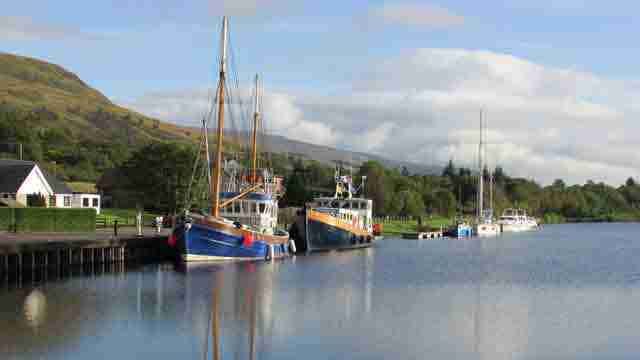
Tucked away in the rugged beauty of the Scottish Highlands lies one of the most remarkable feats of engineering in the UK—the Caledonian Canal. Stretching 60 miles (97 km) from the southwest at Fort William to the northeast at Inverness, this tranquil waterway winds through a landscape of dramatic mountains, glistening lochs, and ancient woodlands. But the canal is much more than just a route; it’s a living, breathing journey through Scotland’s soul.
The Caledonian Canal: A Little History
The Caledonian Canal was designed by one of Britain’s most eminent civil engineers, Thomas Telford. Construction began in 1803 and was completed in 1822, a venture not only to spur the Highland economy but also to make travel by ship through the often turbulent waters around Scotland’s northern coast safer.
The most fascinating aspect of the canal is that it’s not entirely man-made. Only one-third of it is artificial; the rest follows a natural chain of freshwater lochs—Loch Lochy, Loch Oich, and the world-renowned Loch Ness. Together, they form a continuous waterway from sea to sea, linking the Atlantic Ocean with the North Sea.
A Scenic Adventure
Today, the Caledonian Canal is a haven for slow travellers, nature lovers, and anyone with a passion for Scotland’s unspoiled beauty. Whether kayaking, sailing, cycling along the towpaths, or enjoying a gentle promenade, the experience offers one breathtaking view after another.
Starting from Fort William, you’re immediately confronted with the great shadow of Ben Nevis, the UK’s highest peak. Continuing northeast, you ride a sequence of swing bridges and locks, most famous of which is Neptune’s Staircase—a breathtaking run of eight locks that lifts boats up to 60 feet. It’s Britain’s longest staircase lock and an awe-inspiring spectacle even if you’re only watching from the towpath.
From there, the canal flows into Loch Lochy, a long, narrow body of water situated between steep hills. You might catch sight of golden eagles overhead or red deer grazing on the slopes. On misty mornings, the loch has an almost mythical atmosphere, the kind of scene that seems to be plucked straight from Highland legend.
Loch Ness and Legend
Of course, no visit up the Caledonian Canal would be complete without a visit to Loch Ness. At 23 miles in length, this dark, deep loch is the British Isles’ largest by volume—and, naturally, the alleged residence of Nessie, the mysterious Loch Ness Monster. Whether you believe the myth or not, there is no doubt that the loch holds an unreal kind of beauty, especially when viewed from the ruins of Urquhart Castle, which dramatically claims the loch’s northern shore.
A boat tour along Loch Ness is an out-of-this-world experience. The loch is incredibly deep—in excess of 220 meters in some areas—and surrounded by steep wooded hills that rise up vertically from the lake’s shoreline. It’s easy to see how myths can be born here.
Hidden Gems Along the Way
One of the joys of a trip to the Caledonian Canal is discovering the lesser-known, lesser-visited stops on the route. The village of Fort Augustus, for example, is a wonderful spot halfway down the route. Its staircase of locks is forever buzzing with activity during the summer months, and the village itself is full of quaint cafés and viewpoints.
Even further west is Loch Oich, perhaps the most peaceful of the large lochs, largely avoided by visitors rushing to Loch Ness. It is blanketed in woodland and bordered by distant ridges, an excellent place for paddle boarding or an impromptu wild swim on a sweltering summer afternoon.
And don’t miss Laggan Locks, with a floating restaurant and pub—a great spot to refuel with lunch while soaking in views of pine woods and reflected water.
the Caledonian Canal: How to Experience It
There are a number of options to experience the Caledonian Canal, depending on your preference and pace. For the brave, canoeing or kayaking the entire route is a thrilling way to see the route first hand, with campsites and minor harbours along the route.
Alternatively, riding the Great Glen Way, which is a parallel path to the canal, is a popular alternative and makes it simple to take side trips to the surrounding castles, waterfalls, and whisky distilleries.
For those who prefer to take it easy, boat cruises and self-drive canal boats can be rented out for three or seven days. These houseboats offer all the amenities you require, with constantly changing scenery right outside your door.
A Treasure Hunt Journey
The Caledonian Canal is more than a dot on the map—it’s a journey that entwines history, legend, and landscape in a distinctly Scottish manner. Whether you’re driving through the locks, gazing down into the black depths of Loch Ness, or lounging by the fire with a glass of whisky in a Highland pub, the canal invites you to slow down and indulge in the wild, serene magic of the Highlands.
It’s not just about getting from A to B—it’s about everything you experience in between.
Image by Bill Kasman from Pixabay

