Dunfermline rises gently above the western edge of Fife, a town of warm sandstone, winding historic streets, and a royal legacy that stretches back over a thousand years. Once the capital of Scotland, the burial place of kings, and the birthplace of Andrew Carnegie, Dunfermline wears its history with quiet pride — ancient abbey walls stand beside elegant parkland, and every corner seems to hold a story that shaped the nation.
Dunfermline Abbey
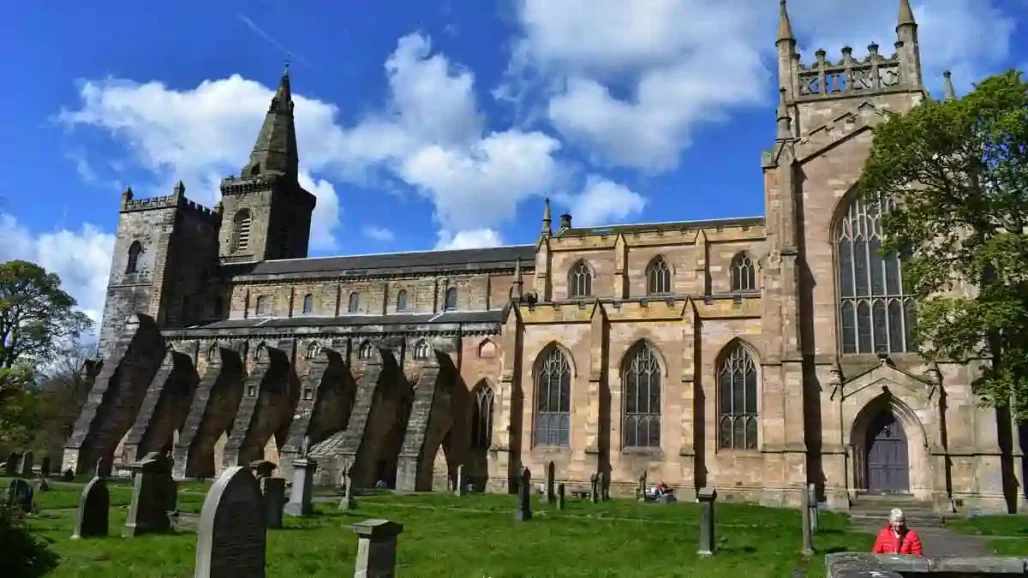
The heart of the town — and of medieval Scotland — is Dunfermline Abbey. Founded in the 11th century by Queen Margaret, later Saint Margaret, this magnificent church grew to become one of the most important religious and political centres in the land. Its Romanesque nave, with massive rounded pillars and chevron-carved stonework, survives almost intact from the 12th century — a breathtaking space where light falls through narrow windows onto stone worn smooth by generations of worshippers. Here lie the remains of Robert the Bruce, whose heart was carried to the Holy Land and returned here, and whose body rests beneath the choir marked by a simple but powerful memorial. More than 20 Scottish royals were crowned or buried at Dunfermline — this was where the kingdom’s soul resided.
Attached to the abbey stands Dunfermline Palace, once a favoured residence of Scottish monarchs. James IV, Mary Queen of Scots, and Charles I all lived here; the great hall, gatehouse, and beautiful stone courtyard still stand, inviting visitors to walk where royalty walked. From the palace walls you look out across the Pittencrieff Glen — a deep, wooded ravine where the Tower Burn tumbles through mossy rocks and ancient trees. This was the royal hunting ground, and today it is the town’s most beloved green escape — paths wind down past waterfalls, past the ruins of Malcolm Canmore’s Tower, to the banks of the Lyne Burn. It is hard to believe this peaceful glen sits right in the town centre.
Dunfermline’s story took another remarkable turn in the 19th century, when it became the birthplace of Andrew Carnegie. Born here in 1835 in a small weaver’s cottage, he left for America as a boy, built an industrial empire, and never forgot his hometown — returning to gift libraries, parks, public baths, and the magnificent Carnegie Library that still stands at the heart of the town. Today the Andrew Carnegie Birthplace Museum tells his extraordinary story — from humble beginnings to global philanthropy — and stands as a reminder of what one person can give back. The museum is free, welcoming, and deeply inspiring.
Beyond its famous landmarks, Dunfermline is a town to wander. The High Street blends historic architecture with independent shops, cafes, and galleries — warm, bustling, and full of character. Parks such as Pittencrieff Park — gifted by Carnegie — offer sweeping views, peacocks, glasshouses, and quiet corners where you can sit and watch the world go by. And because it sits on the western edge of Fife, Dunfermline is the perfect gateway to the rest of the kingdom — the coast, the East Neuk villages, and the hills of Perthshire are all within easy reach.
Dunfermline is more than a historic site — it is a living, breathing city where the past is not locked away, but part of everyday life. From the abbey bells ringing across the rooftops to the glen’s green embrace, from royal roots to modern renewal, this is a place that feels both timeless and full of promise. Whether you come for the kings, the stories, the parks, or simply to wander a town that holds Scotland’s heart so gently — Dunfermline welcomes you.
Essentials
📍 Dunfermline, Fife
⛪ Dunfermline Abbey & Palace — Historic Environment Scotland, open daily
🏠 Andrew Carnegie Birthplace Museum — free entry, year-round opening
🌳 Pittencrieff Park & Glen — free access, woodland walks, peacocks, glasshouses
🚂 Direct train from Edinburgh in 30 minutes — easily accessible
✨ Best time to visit: autumn when the glen turns gold; spring for abbey gardens
Photo by Zsolt Bognar on Unsplash